
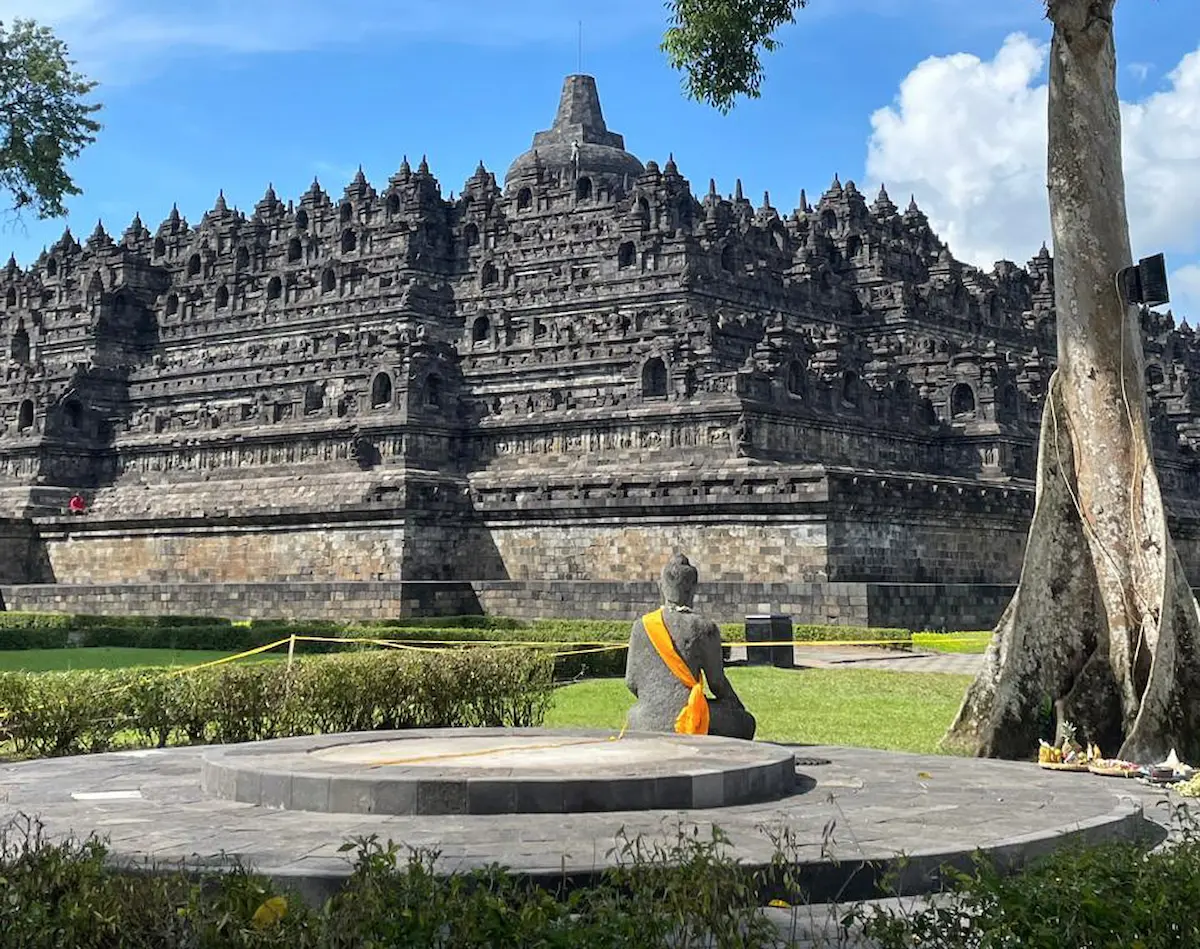
Unfinished Buddha, an Unfinished Statue Full of Puzzles
Borobudur Temple, the world's largest Buddhist architectural masterpiece and a UNESCO World Heritage site, was thought to have been lost for centuries before being rediscovered in 1814 by Sir Thomas Stamford Raffles.
After going through a series of gradual restoration processes since the Dutch East Indies era, Borobudur Temple still leaves mysterious historical traces with the discovery of the "Unfinished Buddha" statue.
The Unfinished Buddha is one of the main attractions of the Borobudur Temple complex and has always been housed in the Karmawibhangga Museum. After a long period of storage, the statue was moved to the Borobudur Temple courtyard, making it more accessible to visitors. Learn more about the Unfinished Buddha in the review below.
Unfinished Buddha, the Mystery of the Unfinished Statue at Borobudur Temple
The Unfinished Buddha statue is the name given by archaeologists to a Dhyani Buddha statue whose construction is believed to have never been fully completed. Among the people around Borobudur, this statue is better known as "Mbah Belet."
Upon closer inspection, several parts of the statue, such as the hands, feet, and body, appear to have been incompletely carved. Furthermore, some parts are damaged or missing, particularly on the forehead and face. This is likely due to the materials used, which are considered inferior compared to other statues at Borobudur Temple. This statue is made of andesite, a stone with numerous pores and a loose texture, making it of lower quality.
Furthermore, in terms of size and proportion, the Unfinished Buddha statue's shape does not fully adhere to the Uttam Das Hatala rules, the proportions generally used in the creation of Buddha statues at that time. This condition makes the statue one of the unique and mysterious relics in the Borobudur area.
Who First Discovered This Mysterious Statue?
The unfinished Buddha statue was first discovered during the reconstruction of Borobudur Temple during the reign of Theodoor Van Erp from 1907–1911. At that time, the Dutch East Indies government instructed the statue to be moved to the temple courtyard based on the advice of NJ Krom and DDK Bosch.
The reason is, this opinion is strengthened by the absence of the statue in The History of Java written by Thomas Stamford Raffles in 1817. However, other notes made by FC Wilsen in 1849–1853 when sketching the Borobudur reliefs show that there was an unfinished Buddha statue carved inside the main stupa.
However, if we look further back, records of an unfinished Buddha statue are also contained in the Serat Centhini which was initiated by Kanjeng Gusti Pangeran Adipati Anom Amangkurat III in 1820. This Serat strengthens the evidence that the initial location of the Unfinished Buddha was on top of Borobudur Temple.
Who is the figure depicted in the statue?
Dutch researcher and archaeologist W.F. Stutterheim believes the Unfinished Buddha statue is Bhatara Buddha, based on sources from the ancient Javanese scripture Sang Hyang Kamahayanikan.
According to Stutterheim, the total number of statues at Borobudur Temple should be 505, but currently there are only 504, leaving one missing. Therefore, Stutterheim concluded that the incomplete Buddha statue is Bhatara Buddha.
Generating Various Opinions Among Experts
From ancient times to the present day, the authenticity and meaning of the Unfinished Buddha statue remain a matter of debate. The statue's uniqueness has even sparked varying opinions among experts . Here 's a breakdown:
- Hartman (1842), a Dutch Administrator who served in Kedu, said that the statue probably came from the main stupa room.
- Govinda (1976) said that the statue represents Adi-Buddha emerging from emptiness in a similar way to Adi Buddha Vajradhara being at the top Gyantsesku'bum.
- Soekmono (1976) Offering a different view, he stated that the statue could not represent Adi-Buddha, or Buddha in his highest position, due to its imperfect condition. Therefore, he argued, the statue could not have been placed inside the main stupa, following the original concept.
- Gangchen and Gyatso (1993)These experts agree with Soekmono. Gengchen said that the statue in the main stupa was likely made of gold and had been stolen long ago.
In addition, some texts and manuscripts in Bstan-'gyur on how to fill the Stupa also inform that only the highest class images and materials may be placed inside the Stupa.
Unfinished Buddha Statue Activation During Peak Holiday Season
The mystery and uniqueness of the Unfinished Buddha statue not only raises debate among experts, but is also a special attraction for visitors to Borobudur Temple.
Based on this, the statue, previously preserved in the Karmawibhangga Museum, was moved to the Borobudur Temple courtyard, specifically to the Kenari courtyard to the west of the temple. This step demonstrates the government's appreciation and support for the preservation of local traditions and cultural values.
Until now, the people of the Borobudur area still revere the Unfinished Buddha statue as an object related to spirituality and positive energy for various aspects of people's lives.
Interestingly, during the busy school holidays, from June 20 to July 20, 2026, Taman Wisata Candi (Temple Tourism Park) will be activating the Unfinished Buddha statue. During this activation period, you can visit Mbah Belet's location in Kenari Park and give him tuberoses.
This step aims to provide visitors with a more meaningful experience while also providing a direct appreciation of the historical and philosophical value of the Unfinished Buddha.
Explore the Mystery of the “Unfinished Buddha” at Borobudur Temple
After reading a brief history of the Unfinished Buddha statue, are you interested in visiting and seeing the uniqueness and mystery of this statue in person?
So, don't miss out, as this activation only lasts until July 20, 2026. Secure your tickets to Borobudur Temple now by purchasing them online through the official InJourney Destination website . You can choose between the Temple Courtyard or Temple Climbing tickets , depending on your vacation plans.
You can also buy it online offline through the ticket counter available at Borobudur Art Village, yes. See you!