


Contents of the Ratu Boko Inscription, a relic from the Ancient Mataram Period
The Ratu Boko site is believed to have been built by King Boko, Roro Jonggrang's father. In other words, legend holds that Ratu Boko Palace was the palace where Roro Jonggrang lived. However, can this be proven by history?
Understanding the Ratu Boko inscription can help you uncover the history of this magnificent site. Built during the Ancient Mataram era, the site is believed to have been formerly called Abhayagiriwihara, after the inscription that records its construction. Let's find a more complete explanation of the Ratu Boko inscription in the review below.
Is it true that Ratu Boko Palace is the home of Roro Jonggrang?
According to legend, Keraton Ratu Boko was the palace of Queen Boko, the father of Roro Jonggrang. Not without reason, this magnificent structure, perched on a hill, features several residential-like structures, including the keputren (female palace), paseban (a pavilion), and pendapa (a pavilion), as well as the main gate, which resembles an entrance.
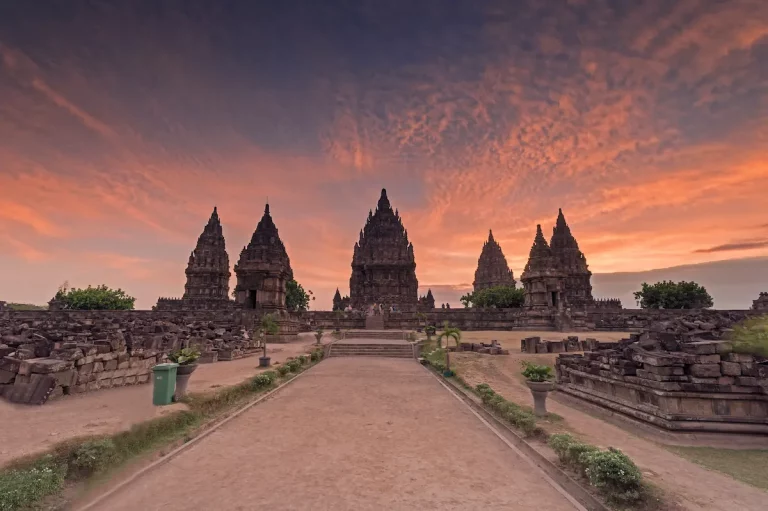
Due to its proximity to Prambanan Temple, the legends of these two historical sites are also intertwined. This legend also states that Ratu Boko was a giant king who frequently ate humans. This naturally sparked widespread unrest, leading the ruler of a neighboring kingdom to send his son, Bandung Bondowoso, to attack Ratu Boko.
Bandung Bondowoso won the battle with the death of Ratu Boko. One day, Bandung Bondowoso met and fell in love with Roro Jonggrang, who turned out to be King Boko's daughter. However, Roro Jonggrang rejected Bandung Bondowoso's love because she refused to marry the man who had killed her father.
The refusal was not stated directly, but rather by making conditions that Bandung Bondowoso could not fulfill, namely building a thousand temples in one night and they had to be completed before dawn.
Bandung Bondowoso agreed and enlisted the help of supernatural forces to complete the construction of the thousand temples. Seeing this, Roro Jonggrang became concerned and manipulated Bandung Bondowoso by having the maidens pound the mortar to induce the rooster to crow, signaling that the deadline had passed.
Because of this, Bandung Bondowoso only managed to complete 999 temples. Feeling cheated, Bandung cursed Roro Jonggrang to become a stone to complete the thousand temples. This became the legend behind the founding of Prambanan Temple.
But, as you know, the legend is merely an attraction, not a historical basis for the Ratu Boko site's founding. Historically, this ancient structure was built in the 8th century by the Syailendra Dynasty.
Also read: Revealing the Myths of Prambanan Temple: Is It True That Couples Can Break Up?
Ratu Boko Inscription: Facts about the Construction of the Ratu Boko Palace
The history of the Ratu Boko site is recorded in the Ratu Boko inscription, also known as the Abhayagiri Wihara inscription . Dated to 792 AD, this inscription dates from the Medang Mataram Kingdom.
In the Abhayagiri Wihara Inscription written using the Pranagari script, a figure named Tejahpurnapane Panamkarana or also known as Rakai Panangkaran is recorded and mentions an area called Abhayagiri Wihara which is a monastery on a hill.
Not only the Abhayagiri Wihara Inscription (Boko I Inscription), in the Ratu Boko Palace complex, three other inscriptions were also found, namely:
- Boko II Inscription: Recording the establishment of a Lingga by Sri Kumbhajaya or Rakai Walaing Pu Kumbhayoni.
- Boko III Inscription (Tryambakalingga Inscription): Contains notes about the establishment of a linga worship building for Lord Shiva by Sri Kumbhajaya.
- Boko IV Inscription (Haralingga Inscription): Explains the establishment of a sacred building in the form of a linga by Kalasodbhawa.
History of Ratu Boko Palace
Based on the Abhayagiri Wihara inscription, historians agree that the Ratu Boko site was originally called Abhayagiri Wihara, built by Rakai Panangkaran, the second king of the Medang Mataram Kingdom. It was here that Rakai Panangkaran focused on meditation after his retirement, spending his time there until the end of his life.
Uniquely, Abhayagiri Vihara is also the name of one of Sri Lanka's Buddhist religious centers. The monastery complex is quite extensive and is inhabited by thousands of monks. It was from this religious center that Mahayana Buddhist teachers were sent out of Sri Lanka.
Historian JG de Casparis, who studied the Abhayagiri Wihara inscription, noted a connection between Java and Sri Lanka. This led to the assumption that the construction of the Ratu Boko site was inspired by the Abhayagiri Wihara in Sri Lanka.
About half a century later, the Ratu Boko site was taken over by Mpu Khumbayoni, also known as Rakai Walaing. According to the Siwagraha Inscription, Rakai Walaing made several modifications, building a stone fort on the hillside. This has led to the assumption that the current stone structure at the Ratu Boko site is not the original structure, but rather a modification of Rakai Walaing's.
Mpu Khumbayoni's power caused unrest among the people, prompting Dyah Lokapala, Rakai Pikatan's youngest son, to lead the Medang army to attack Mpu Khumbayoni, ultimately defeating his group. Dyah Lokapala then restored the Ratu Boko site to its original function as a place of worship.
After the Medang troops regained control of the Ratu Boko site, it was the turn of Mpu Khumbayoni's elements to be destroyed.
Who First Discovered Ratu Boko Palace?
The ruins of Ratu Boko Palace were first discovered by van Boeckholtz in 1790 and restoration began in 1938. This restoration had begun during the Dutch colonial era, and continued during the Japanese occupation.
According to research conducted by historians, the Ratu Boko site is a settlement that was inhabited in four phases, each of which is explained below:
- Phase I: Inhabited during the period 600–825 AD. The end of this phase is estimated to be in the same era as the creation of the Abhayagiri Wihara Inscription (792 AD).
- Phase II: Inhabited during the period 775/825–1025/1050 CE, it is thought to have been inhabited by Shivaists. During this period, the Ratu Boko site was controlled by Rakai Walaing, a Hindu.
- Phase III: Inhabited during the period 1025/1050 AD – 1250/1400 AD.
- Phase IV: It is estimated to have lasted during the period 1250/1400–1850 AD and was an uninhabited location.
Also read: Recommended Places to Relax in Jogja While Hunting for Sunset
Traces of Ratu Boko Civilization in the Present
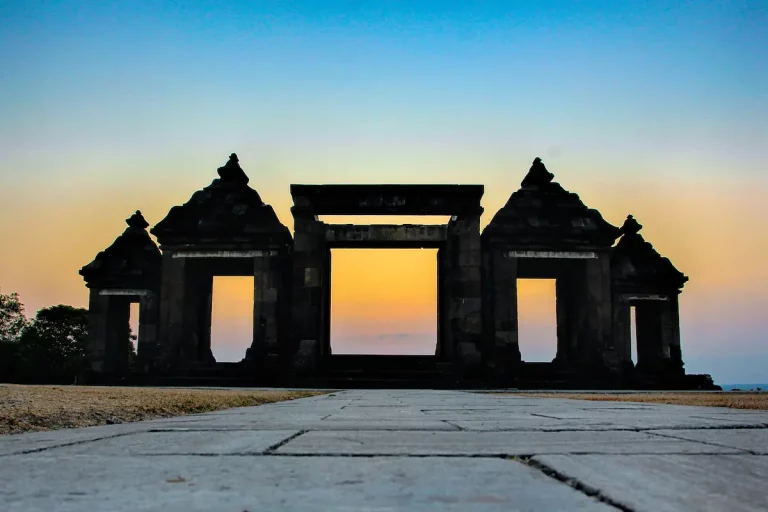
Currently, Ratu Boko Palace is managed by Injourney Destination Management and is a historical destination not to be missed when visiting Yogyakarta. Upon entering the site, you'll be greeted by a magnificent gate structure. Especially if you arrive in the afternoon, you can enjoy an even more enchanting view, with the sunset reflecting off the sturdy gate walls.
Beyond its history, Ratu Boko Palace is a beautiful and enchanting historical site. Every trace of ruins still visible today testifies to the grandeur of the structure during that era. The grandeur of the structure, the serene atmosphere, and the beautiful natural panorama of the hills make you feel like you've entered a fairytale world.
In fact, now you can also enjoy cultural dance performances that tell the legend of Ratu Boko Palace according to the specified schedule, you know.
After successfully captivating tourists with several previous performances, Ratu Boko returns with a performance titled Sandyakala Prabu Boko on August 15, 2026. This performance is free for visitors with admission tickets. So, there's no additional cost!
Additionally, there are many exciting package deals available at Ratu Boko Palace, including Boko Picnic and Boko Sunset . You can even take advantage of the aesthetic panorama of Ratu Boko Palace for pre-wedding photos.
By the way, now is the perfect time to secure tickets to Ratu Boko Palace. A 30% discount on adult tickets for domestic tourists awaits. This promotion runs from July 27 to August 7, for visits between August 3–7, 2026.
What are you waiting for? Take advantage of this opportunity to save money and visit this stunning historical site, home to countless stories. Secure your Ratu Boko Palace tickets online now through the official Injourney Destination Management website.
Also read: 7 Recommended Romantic and Romantic Tourist Attractions in Sleman